
More Information
For additional information on cross bores:
Visit: www.crossboresafety.org
Email: damageprevention@peoples-gas.com
Call: 1-866-284-1010
Sewer Line Safety
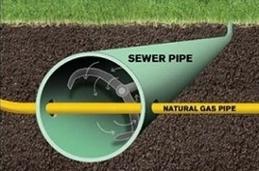
In rare cases, our gas pipeline may cross through a sewer pipe. This is known as a cross bore. If a plumber unknowingly strikes a gas line while cutting through a sewer blockage, natural gas could enter the sewer system. We want to prevent this from happening.
Why can utility lines cross through sewer lines? When a new utility line (gas, electric, telephone, or cable) needs to be installed in an urban area, it’s very common for utility providers to use/utilize trenchless technology. Since this installation method does not involve digging a trench, it avoids damage to sidewalks, patios, landscaping, and existing utility lines.
Is it dangerous to clean out sewers? Cleaning out sewers can be potentially hazardous when sewer laterals are cleaned using mechanical purging equipment (rooter). This equipment has the ability to damage buried utilities. Collapsed sewer walls can also cause the rooter equipment to be misdirected outside of the sewer, bringing the equipment dangerously close to other buried utilities.
What is a Cross Bore?
Be Safe! Always assume that obstructions involve a cross bore.
A cross bore is defined as the intersection of an existing underground utility or underground structure by a second utility installed using trenchless technology. This results in an intersection of the utilities, compromising the integrity of either or both utility or underground structure.
In rare cases, our gas pipeline may cross through a sewer pipe. If a plumber unknowingly strikes a gas line while cutting through a sewer blockage, natural gas could enter the sewer system, creating a dangerous situation. For this reason, it is extremely important to call 811 before you begin any digging project to have all utility lines clearly marked.
Always assume that obstructions involve a cross bore. If a natural gas pipeline is hit:
DO | DO NOT |
Leave the premises immediately | Operate any electrical appliances while in the premises |
Instruct others to leave right away | Operate any pipeline system equipment |
Contact Peoples from a safe location at 1-800-400-4271 | Turn vehicles, appliances, or lights on or off |
Call 911 | Use anything that might create a spark, such as a cell phone |
Keep others at a safe distance |
|
How to Prevent Damage
Below you'll find the steps that a plumber should take as you move through the sewer line cleaning process.
Before You Begin
- Call 811 for utility line locations. This measure may help to identify intersecting lines.
- Whenever possible, utilize an outside trap to clean out the sewer line.
- Look for trees or landscaping that could be causing an obstruction.
- Ask the resident if there has been any recent utility work in the area.
- Use an in-line camera inspection device, as it will help to assess the blockage.
During the Cleaning
- Do not use a cutting tool. This applies when clearing both sewer laterals and drains.
- Use minimally invasive equipment such as a plumbing snake or water jet to attempt to clear the blockage.
- Feel for obstructions that do not seem to resemble tree roots or other common obstructions as the tool moves through the sewer line.
When You Are Finished
We do not recommend that you use a cutting tool. However, if you have used one:
- Check the blades for yellow or orange plastic when it is withdrawn from the sewer line. Natural gas utility lines are typically made of these two colors of plastic.
- Watch for bubbles caused by natural gas escaping from the toilet or other entry point of the cutting tool.
- Inspect the area with a Combustible Gas Indicator (CGI) or other gas-detection equipment.
If a Cross Bore Occurs
- Leave the premises immediately.
- Instruct others to leave the area right away.
- Contact Peoples from a safe location at 1-800-400-4271.
- Call 911.
- Keep others at a safe distance.